Wednesday, January 20, 2010

Habitats at Morningside Nature Center

[taken in part from a friend's blog]


Our group took a lovely field trip this week to Morningside Nature Center. They’ve been doing programs for both public and home schooled children for years, and it shows. Their presentation was well-organized, engaging, and really reached the kids.

The title was “Animal Homes.” There was a brief discussion of animals’ physical adaptations which give them advantages in their environments (complete with skeletons and taxidermy for illustration), then the focus moved to habitats. The kids learned that the 4 necessary components of any habitat are: food, water, shelter, and space. Then the fun part began.
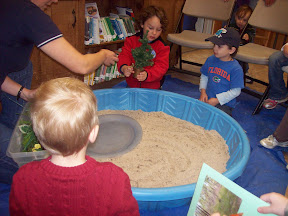

Each student was given a small plastic animal and a laminated sheet with information about it. Then, with the presenter’s guidance, they built a habitat for the animals in a big wading pool filled with sand that included all the necessary elements. The presenter talked them through the food chain and how it influenced the spacing and placement of different species. One of the children was feeling contrary and refused to place his frog in the habitat, but instead of derailing the lesson, the presenter used the frog’s absence to demonstrate how the entire ecosystem could be disrupted by the destruction of one species. It was really quite ingenious.

Then she used a toy bulldozer to level some trees and build a “house” by the lake, and she talked about all the various ways that humans dwelling in that particular spot were likely to cause damage. She guided the kids through ways that humans could more thoughtfully establish their own habitat within the system to minimize environmental impact, and the kids really got into it. It warmed my heart, I have to say.

Then we went on a nature walk. It was quite cold, so we didn’t see any animals, but our guide pointed out many signs showing where they’d been.

Sunday, December 13, 2009

Learning about Bats

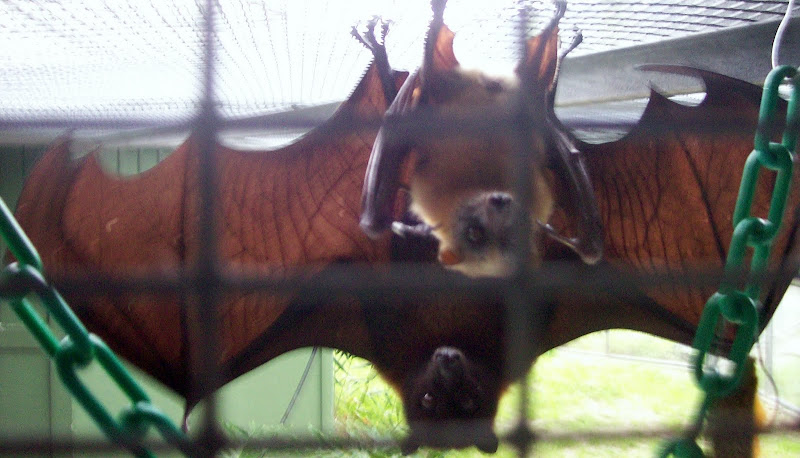
The Lubee Bat Conservancy is about 10 miles north of Gainesville, not too far from our own dwelling. The Conservancy’s focus is on plant-visiting “fruit and nectar” bats, which include the giant flying foxes with wingspans up to to six feet. They are absolutely gorgeous.


We learned that most fruit-and-nectar bats are “macro-bats,” while most insectivorous bats are “micro-bats.” While the micro-bats have the large ears and tiny bodies that allow them to hear their prey and swiftly chase it, macro-bats have relatively small ears, but large eyes and noses to help them find their food.

Monday, November 23, 2009

Cuttlefish, Chromatophores, & Coolness

Today, thanks to Creature Cast, we learned about both multicellular organisms and squid iridescence. Although I think much of it was over P's head, he seemed to grasp some of it. We talked about it more, made reference to how the iridescence was similar to butterfly wings (like in the video), and then sought out videos to showcase it in "real life".

we looked at some of Loligo squid (the kind mentioned in the Creature Cast), including some neat light displays. At about that point, we watched the NOVA "About Cuttlefish" short, and had to learn more!

NOVA has a website on these "Kings of Camouflage", and we enjoyed learning more about the Anatomy of a Cuttlefish (including its weird W-shaped pupil, its 200 chromatophores or pigment cells per square millimeter, and its blue-green blood!) and watching videos of these Quick Change Artists.

Pretty awesome stuff.

Friday, November 13, 2009

The Buzz about Bees

We attended a presentation on honey bees at the Museum of Natural History. They all enjoyed the program. The learned about the different classes of bee (queen, worker, drone, etc.), the fact that bees can be promoted from one job to another, and what different “dance moves” mean in communicating the location of food. Apparently there was a movie and honey samples, so it must have been good.

Monday, August 24, 2009

Owl Sanctuary


Today, we went with our homeschooling group to the Owl Sanctuary down in Ocala (actually called the Ocala Wildlife Sanctuary). This is a non-profit organization that specializes in rescuing birds of prey, primarily owls. We heard about the owls, how they are able to hunt using sound (echolocation) and that they don't need daylight to see.


There were many other birds and fowl there, including ducks, a parrot, a kestrel, a crow, a goose, and more. We saw screech owls, barred owls, great horned owls, and barn owls. Because it was daylight and many of the birds were in heavily secured "mews" (for their safety as well as ours), it was a bit hard to see them, and very hard to photograph them.

We ended the tour by receiving an owl pellet to take home and dissect (this is the undigestible parts of the animal that the owl fed on). Ours was a dark brown one, which should be a barred owl's pellet. It will be a fun thing to dig through.

Sunday, August 23, 2009

Not Back to School Potluck


Today, along with six other homeschooling families, we celebrated not going back to school. A potluck gathering meant lots of fun and socializing to be had, for kids, moms and dads alike! Among this setting, there were groups forming to act out the Boxcar Children, a children's army, petting and caring for the goats, dress-up, water play, trains, LEGOs, and archery.


It was really a great way to continue our summer past the arbitrary school calendar cut-off. It was a hard transition to leave for pretty much everyone. Luckily, we'll see almost everyone again tomorrow (most dads will be back to work, and miss our fun trip to the owl sanctuary!).

Thursday, August 20, 2009

Leo Building: Mars Base

K and P collaborated on building a Mars base, complete with green houses and tunnels from building to building.