Showing posts with label listening. Show all posts
Showing posts with label listening. Show all posts
Tuesday, May 4, 2010
Wednesday, April 28, 2010
Two Tails Ranch
[taken in part from a friend's blog]
15 miles south of Gainesville in Williston is a large animal rescue/sanctuary, the Two Tails Ranch. We went there this week with our home school group to see elephants, zebras, giant tortoises, tigers, ostriches and more.
It turns out that the reason she was “dancing” is because elephants are so heavy, they have to stay in constant movement or their organs will become crushed under their own weight. This is also why they sleep standing up; lying down for more than 20-30 minutes causes fluid to build up in their lungs. Amazing.
The elephants at Two Tails are all Asian elephants, distinguished from their African cousins by smaller ears, lighter skin, no tusks for the females, two domes on the head instead of one, and a difference in toe count. The lighter skin pigment includes freckles, as see on this female’s face:

The information given was rather sobering. Unless current bans on importing elephants to the US are lifted and intensive breeding programs are implemented, these endangered animals will likely be extinct in the next 75-100 years. They require enormous amounts of land in order to thrive, as they are destructive of their habitats and must migrate often. Unfortunately, current preserves are insufficient, and elephants in Asia are being culled as nuisance animals in areas heavily populated by humans. Their shrinking habitat has also caused insufficient genetic diversity among potential mates for healthy offspring. Add to this the fact that elephants are actually choosy about their mates, and the birth rate is drastically insufficient to keep up with the death rate.
Luke, a beautiful male, did a log-manipulation demonstration for us. He also lay down for the trainer, which she said requires absolute trust, as that is the elephant’s most vulnerable position, since they can’t get up quickly.

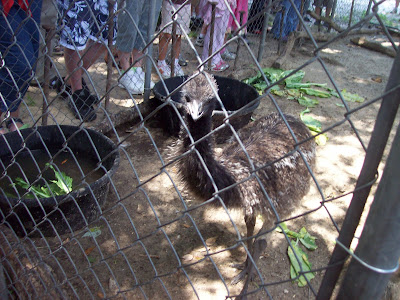
This emu is about 4 months old, half the size of an adult. A handler picked it up and let the kids pet the feathers on his back.
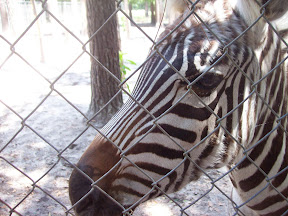
The sanctuary also had several zebras. We learned that predators see mostly in black and white, so the zebras’ stripes make it hard for the predators to distinguish individual animals in a herd, which discourages attack. The zebras were fearless and came right up to our group to check us out:

15 miles south of Gainesville in Williston is a large animal rescue/sanctuary, the Two Tails Ranch. We went there this week with our home school group to see elephants, zebras, giant tortoises, tigers, ostriches and more.
It turns out that the reason she was “dancing” is because elephants are so heavy, they have to stay in constant movement or their organs will become crushed under their own weight. This is also why they sleep standing up; lying down for more than 20-30 minutes causes fluid to build up in their lungs. Amazing.
The elephants at Two Tails are all Asian elephants, distinguished from their African cousins by smaller ears, lighter skin, no tusks for the females, two domes on the head instead of one, and a difference in toe count. The lighter skin pigment includes freckles, as see on this female’s face:

The information given was rather sobering. Unless current bans on importing elephants to the US are lifted and intensive breeding programs are implemented, these endangered animals will likely be extinct in the next 75-100 years. They require enormous amounts of land in order to thrive, as they are destructive of their habitats and must migrate often. Unfortunately, current preserves are insufficient, and elephants in Asia are being culled as nuisance animals in areas heavily populated by humans. Their shrinking habitat has also caused insufficient genetic diversity among potential mates for healthy offspring. Add to this the fact that elephants are actually choosy about their mates, and the birth rate is drastically insufficient to keep up with the death rate.
Luke, a beautiful male, did a log-manipulation demonstration for us. He also lay down for the trainer, which she said requires absolute trust, as that is the elephant’s most vulnerable position, since they can’t get up quickly.

This emu is about 4 months old, half the size of an adult. A handler picked it up and let the kids pet the feathers on his back.
The sanctuary also had several zebras. We learned that predators see mostly in black and white, so the zebras’ stripes make it hard for the predators to distinguish individual animals in a herd, which discourages attack. The zebras were fearless and came right up to our group to check us out:


Wednesday, January 20, 2010
Habitats at Morningside Nature Center
[taken in part from a friend's blog]

Our group took a lovely field trip this week to Morningside Nature Center. They’ve been doing programs for both public and home schooled children for years, and it shows. Their presentation was well-organized, engaging, and really reached the kids.
The title was “Animal Homes.” There was a brief discussion of animals’ physical adaptations which give them advantages in their environments (complete with skeletons and taxidermy for illustration), then the focus moved to habitats. The kids learned that the 4 necessary components of any habitat are: food, water, shelter, and space. Then the fun part began.
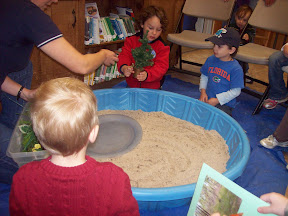

Each student was given a small plastic animal and a laminated sheet with information about it. Then, with the presenter’s guidance, they built a habitat for the animals in a big wading pool filled with sand that included all the necessary elements. The presenter talked them through the food chain and how it influenced the spacing and placement of different species. One of the children was feeling contrary and refused to place his frog in the habitat, but instead of derailing the lesson, the presenter used the frog’s absence to demonstrate how the entire ecosystem could be disrupted by the destruction of one species. It was really quite ingenious.
Then she used a toy bulldozer to level some trees and build a “house” by the lake, and she talked about all the various ways that humans dwelling in that particular spot were likely to cause damage. She guided the kids through ways that humans could more thoughtfully establish their own habitat within the system to minimize environmental impact, and the kids really got into it. It warmed my heart, I have to say.
Then we went on a nature walk. It was quite cold, so we didn’t see any animals, but our guide pointed out many signs showing where they’d been.

Our group took a lovely field trip this week to Morningside Nature Center. They’ve been doing programs for both public and home schooled children for years, and it shows. Their presentation was well-organized, engaging, and really reached the kids.
The title was “Animal Homes.” There was a brief discussion of animals’ physical adaptations which give them advantages in their environments (complete with skeletons and taxidermy for illustration), then the focus moved to habitats. The kids learned that the 4 necessary components of any habitat are: food, water, shelter, and space. Then the fun part began.

Each student was given a small plastic animal and a laminated sheet with information about it. Then, with the presenter’s guidance, they built a habitat for the animals in a big wading pool filled with sand that included all the necessary elements. The presenter talked them through the food chain and how it influenced the spacing and placement of different species. One of the children was feeling contrary and refused to place his frog in the habitat, but instead of derailing the lesson, the presenter used the frog’s absence to demonstrate how the entire ecosystem could be disrupted by the destruction of one species. It was really quite ingenious.
Then she used a toy bulldozer to level some trees and build a “house” by the lake, and she talked about all the various ways that humans dwelling in that particular spot were likely to cause damage. She guided the kids through ways that humans could more thoughtfully establish their own habitat within the system to minimize environmental impact, and the kids really got into it. It warmed my heart, I have to say.
Then we went on a nature walk. It was quite cold, so we didn’t see any animals, but our guide pointed out many signs showing where they’d been.
Sunday, December 13, 2009
Learning about Bats
The Lubee Bat Conservancy is about 10 miles north of Gainesville, not too far from our own dwelling. The Conservancy’s focus is on plant-visiting “fruit and nectar” bats, which include the giant flying foxes with wingspans up to to six feet. They are absolutely gorgeous.
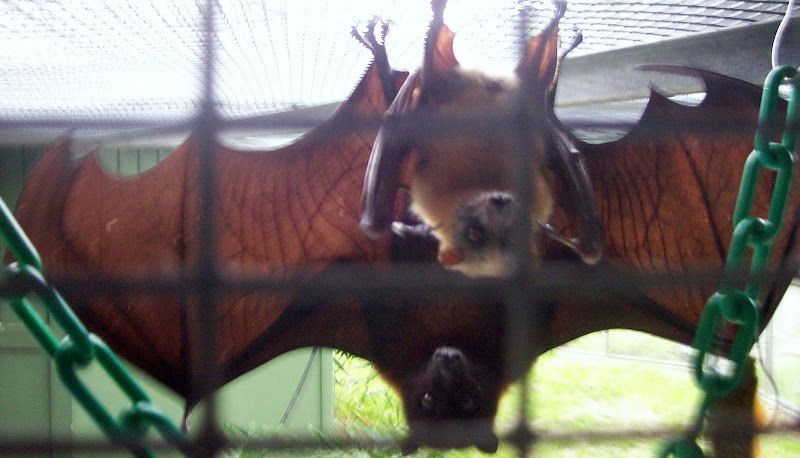
We learned that most fruit-and-nectar bats are “macro-bats,” while most insectivorous bats are “micro-bats.” While the micro-bats have the large ears and tiny bodies that allow them to hear their prey and swiftly chase it, macro-bats have relatively small ears, but large eyes and noses to help them find their food.
We learned that most fruit-and-nectar bats are “macro-bats,” while most insectivorous bats are “micro-bats.” While the micro-bats have the large ears and tiny bodies that allow them to hear their prey and swiftly chase it, macro-bats have relatively small ears, but large eyes and noses to help them find their food.
Friday, November 13, 2009
The Buzz about Bees
We attended a presentation on honey bees at the Museum of Natural History. They all enjoyed the program. The learned about the different classes of bee (queen, worker, drone, etc.), the fact that bees can be promoted from one job to another, and what different “dance moves” mean in communicating the location of food. Apparently there was a movie and honey samples, so it must have been good.
Tuesday, August 18, 2009
City of Ember
"P" and "K" listened to the audio presentation of "City of Ember". Later, they discussed sections of the book with us and incorporated some of the scenarios of the book into their creative play.
Wednesday, August 5, 2009
Little House on the Prairie
P demonstrated his reading comprehension skills this evening as I read a chapter of Little House on the Prairie, which he had been pre-reading for several days. About seven pages into the chapter I came across the phrase 'fever n augue'. Having never heard it before and unsure of how to pronounce it, I trimmed the statement down to 'fever'. Parker immediately corrected me, despite my sitting several feet away and him not being able to see the page from where he was sitting.
Monday, June 22, 2009
Circle Camp Finale

After two weeks of our peace talk-themed summer camp, the kids put on an amazing performance complete with drumming, dancing, singing, and skits. Lots was learned in terms of talking with others compassionately and getting to feelings and needs instead of blame and hurt.


Subscribe to:
Posts (Atom)


