Showing posts with label nature. Show all posts

Wednesday, April 28, 2010

Two Tails Ranch

[taken in part from a friend's blog]

15 miles south of Gainesville in Williston is a large animal rescue/sanctuary, the Two Tails Ranch. We went there this week with our home school group to see elephants, zebras, giant tortoises, tigers, ostriches and more.

It turns out that the reason she was “dancing” is because elephants are so heavy, they have to stay in constant movement or their organs will become crushed under their own weight. This is also why they sleep standing up; lying down for more than 20-30 minutes causes fluid to build up in their lungs. Amazing.

The elephants at Two Tails are all Asian elephants, distinguished from their African cousins by smaller ears, lighter skin, no tusks for the females, two domes on the head instead of one, and a difference in toe count. The lighter skin pigment includes freckles, as see on this female’s face:


The information given was rather sobering. Unless current bans on importing elephants to the US are lifted and intensive breeding programs are implemented, these endangered animals will likely be extinct in the next 75-100 years. They require enormous amounts of land in order to thrive, as they are destructive of their habitats and must migrate often. Unfortunately, current preserves are insufficient, and elephants in Asia are being culled as nuisance animals in areas heavily populated by humans. Their shrinking habitat has also caused insufficient genetic diversity among potential mates for healthy offspring. Add to this the fact that elephants are actually choosy about their mates, and the birth rate is drastically insufficient to keep up with the death rate.

Luke, a beautiful male, did a log-manipulation demonstration for us. He also lay down for the trainer, which she said requires absolute trust, as that is the elephant’s most vulnerable position, since they can’t get up quickly.


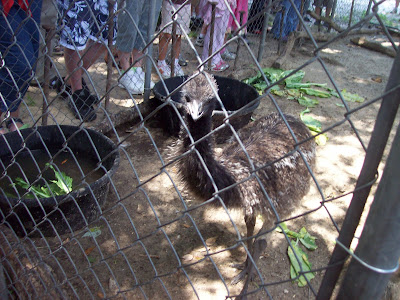
This emu is about 4 months old, half the size of an adult. A handler picked it up and let the kids pet the feathers on his back.

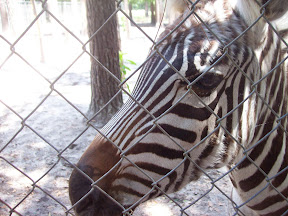
The sanctuary also had several zebras. We learned that predators see mostly in black and white, so the zebras’ stripes make it hard for the predators to distinguish individual animals in a herd, which discourages attack. The zebras were fearless and came right up to our group to check us out:
Wednesday, January 20, 2010

Habitats at Morningside Nature Center

[taken in part from a friend's blog]


Our group took a lovely field trip this week to Morningside Nature Center. They’ve been doing programs for both public and home schooled children for years, and it shows. Their presentation was well-organized, engaging, and really reached the kids.

The title was “Animal Homes.” There was a brief discussion of animals’ physical adaptations which give them advantages in their environments (complete with skeletons and taxidermy for illustration), then the focus moved to habitats. The kids learned that the 4 necessary components of any habitat are: food, water, shelter, and space. Then the fun part began.


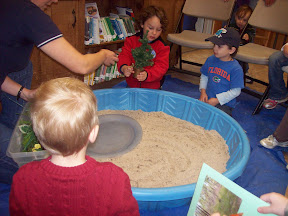
Each student was given a small plastic animal and a laminated sheet with information about it. Then, with the presenter’s guidance, they built a habitat for the animals in a big wading pool filled with sand that included all the necessary elements. The presenter talked them through the food chain and how it influenced the spacing and placement of different species. One of the children was feeling contrary and refused to place his frog in the habitat, but instead of derailing the lesson, the presenter used the frog’s absence to demonstrate how the entire ecosystem could be disrupted by the destruction of one species. It was really quite ingenious.

Then she used a toy bulldozer to level some trees and build a “house” by the lake, and she talked about all the various ways that humans dwelling in that particular spot were likely to cause damage. She guided the kids through ways that humans could more thoughtfully establish their own habitat within the system to minimize environmental impact, and the kids really got into it. It warmed my heart, I have to say.

Then we went on a nature walk. It was quite cold, so we didn’t see any animals, but our guide pointed out many signs showing where they’d been.

Sunday, December 13, 2009

Learning about Bats

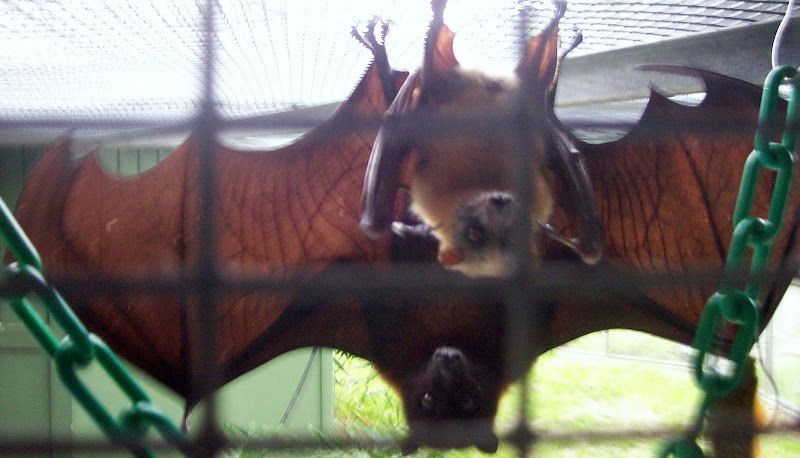
The Lubee Bat Conservancy is about 10 miles north of Gainesville, not too far from our own dwelling. The Conservancy’s focus is on plant-visiting “fruit and nectar” bats, which include the giant flying foxes with wingspans up to to six feet. They are absolutely gorgeous.


We learned that most fruit-and-nectar bats are “macro-bats,” while most insectivorous bats are “micro-bats.” While the micro-bats have the large ears and tiny bodies that allow them to hear their prey and swiftly chase it, macro-bats have relatively small ears, but large eyes and noses to help them find their food.

Monday, November 23, 2009

Cuttlefish, Chromatophores, & Coolness

Today, thanks to Creature Cast, we learned about both multicellular organisms and squid iridescence. Although I think much of it was over P's head, he seemed to grasp some of it. We talked about it more, made reference to how the iridescence was similar to butterfly wings (like in the video), and then sought out videos to showcase it in "real life".

we looked at some of Loligo squid (the kind mentioned in the Creature Cast), including some neat light displays. At about that point, we watched the NOVA "About Cuttlefish" short, and had to learn more!

NOVA has a website on these "Kings of Camouflage", and we enjoyed learning more about the Anatomy of a Cuttlefish (including its weird W-shaped pupil, its 200 chromatophores or pigment cells per square millimeter, and its blue-green blood!) and watching videos of these Quick Change Artists.

Pretty awesome stuff.

Friday, November 13, 2009

The Buzz about Bees

We attended a presentation on honey bees at the Museum of Natural History. They all enjoyed the program. The learned about the different classes of bee (queen, worker, drone, etc.), the fact that bees can be promoted from one job to another, and what different “dance moves” mean in communicating the location of food. Apparently there was a movie and honey samples, so it must have been good.

Monday, August 24, 2009

Owl Sanctuary


Today, we went with our homeschooling group to the Owl Sanctuary down in Ocala (actually called the Ocala Wildlife Sanctuary). This is a non-profit organization that specializes in rescuing birds of prey, primarily owls. We heard about the owls, how they are able to hunt using sound (echolocation) and that they don't need daylight to see.


There were many other birds and fowl there, including ducks, a parrot, a kestrel, a crow, a goose, and more. We saw screech owls, barred owls, great horned owls, and barn owls. Because it was daylight and many of the birds were in heavily secured "mews" (for their safety as well as ours), it was a bit hard to see them, and very hard to photograph them.

We ended the tour by receiving an owl pellet to take home and dissect (this is the undigestible parts of the animal that the owl fed on). Ours was a dark brown one, which should be a barred owl's pellet. It will be a fun thing to dig through.

Friday, August 7, 2009

Ant Lions

"P" and "K" watched a group of ant lion traps surrounding our backyard faucet. We observed how ant lion keeps his trap debris-free by placing leaves in the pit and watching the lion kick it back out again.

Saturday, July 25, 2009

Mineralogy and Geology; gardening

A geologist from the University of Florida talked for thirty minutes today to "K" and "P" of the different types of rocks and minerals and how they form. "P" was able to identify the difference between internal and external in relation to a diagram of a volcano. They were able to hold and feel rocks and minerals of various types, look at them with a magnifying glass, and then drew their own volcanoes and rock formations.

After this activity they helped to pick ripe vegetables in a community garden, and to tell the difference between zucchini that were ready to harvest and which should be left to ripen more.

Friday, July 17, 2009

Whaling

"P" and I discussed the history of whaling. We talked about the uses for blubber, Moby Dick and current whaling practices, including the stand-off between Japanese whaling vessels and environmentalists.

Saturday, July 11, 2009

Cosmos

Watched the first two episodes of Cosmos with Carl Sagan, which talked about the size of the universe and the Rosetta Stone. Later watched an animation showing the relative sizes of astronomical bodies, from the earth all the way to VY Canis Majoris, the largest known star.

Friday, June 26, 2009

Blue Springs exploriation

We enjoyed exploring the spring-fed "watering hole", looking for snails, watching the fish swim past, feeling the cool water.

http://www.bluespringspark.com/

Sunday, June 21, 2009

Amazing Butterflies

Went to Butterfly Rainforest and Amazing Butterfly Exhibit.


Monday, April 20, 2009

Baby Wolf Spiders

We have itty-bitty wolf spider babies running around the house, with no site of mom. Learned how wolf spider mothers normally carry them on their backs until they are big enough to fend for themselves -- these will be hard-pressed to survive. Cats may be culprits.

Wednesday, April 15, 2009

Gopher Tortoise

A Gopher Tortoise took up residence in our back yard. Spent part of the day watching him diligently build up the entrance to his burrow, and looked at video of other tortoises online and how deep their burrows can go.

Wednesday, April 8, 2009

Swallow Tail Kites

A swallowtail kite spent around a half hours circling our neighborhood and back yard this afternoon. K and P watched the spectacle for about half the time, and later watched videos of other swallow tail kites in flight. We talked about kites and how they are related to hawks and eagles.

Tuesday, March 31, 2009

Ft. Clinch Camping

Enjoyed group camping for first time. Explored Ft. Clinch park. Cold water!!


Saturday, March 21, 2009

Butterfly Release

Went to the Florida Museum of Natural History today. We looked at the exhibit of native butterflies and how they pick different native species of plants to lay their eggs, and watched the release of new butterflies into the tropical rain forest enclosure. We also visited the Fossil, Everglades, and Alien Invasion exhibits.

Thursday, March 19, 2009

Can You Dig It?

We attended the Florida Museum of Natural History's annual "Can You Dig It" event tonight. We were able to see the live demonstrations of:
  • an erupting volcano (talking about pyroclastic clouds as well as comparisons of the Pompeii eruption and the Mount St. Helens eruption);
  • "magic rocks" which glow under UV lights (we got to see things glow orange, green, pink, and white) based on their component elements (like calcium);
  • flint knapping, where master flint knapper Tom Nutter was making stone arrow heads the "modern way", and then discussed with us how it would have been done by Native Americans;
  • the work of water and how it shapes Earth's surface and subsurface, including ridges and rivers and canyons;
  • and the ground water system, complete with a 3-D model of a cube of earth down through to the deepest aquifer, and also a water model to show how pollution can get from contaminated sewers, septic tanks, and similar into our drinking water supplies.
We also explored mineral hardness and how a rock with a hardness less than 2.5 (which is the hardness of our nails) would flake when scraped, got to feel different stalagmites and stalactites, looked at shavings of different "rocks" under the microscope (including granite and limestone), and saw the gem cutting process (from mining the minerals to extracting the "pretty part" to shaping to setting for jewelry). We also briefly participated in the "fossil dig", but were less than impressed with it, as it was just a sandbox with different mineral rocks thrown in there -- there was no "excavating" required.

Wednesday, March 18, 2009

Manatee Springs

Visited Manatee Springs state park for a nature trail exploration and picnic. K and P saw:

  • red-tailed hawk
  • sea lettuce
  • turtles
  • black vultures
  • yellow buttons (possible)

Saturday, January 31, 2009

Horses and Butterflies

P and K visited the Mill Creek Horse Retirement Farm and Butterfly Museum today with Aunt Shelli.